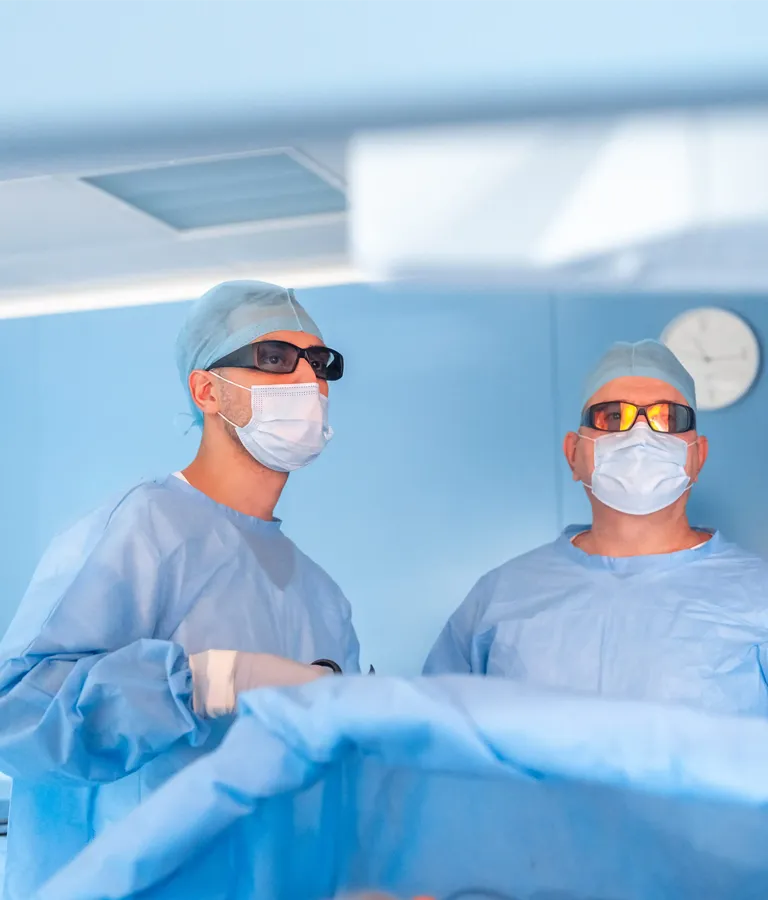


At the Bariatric Surgery Center, a surgery took place that became an important milestone for our team. A patient with morbid obesity grade III underwent a laparoscopic sleeve gastrectomy using a modern three-dimensional visualization system - 3D laparoscopy.
A distinctive feature of this procedure was not only the use of advanced technology but also the involvement of the entire surgical team of the center. During the operation, bariatric surgeons Oleksandr Ivanko, Serhii Trepet, and Emir-Useinov Tair Seitkhalilovych worked together, while anesthesiological support was provided by Vitalii Korchak.
Patient history
A 39-year-old man came to the center who had been struggling with excess weight for many years. Despite numerous attempts to lose weight through diets, dietary restrictions, and other conservative methods, no sustainable results were achieved.
At the time of consultation:
- weight - 165 kg;
- height - 183 cm;
- body mass index - 42.97 kg/m².
In addition to morbid obesity, the patient was diagnosed with metabolic syndrome and non-alcoholic fatty liver disease.
The excess weight had already begun to affect his overall health, reducing quality of life and increasing the risk of serious complications related to the cardiovascular system, metabolism, and musculoskeletal system.
After a full examination, specialist consultations, and discussion of possible treatment options, a decision was made to perform bariatric surgery.
Why sleeve gastrectomy was chosen
Sleeve gastrectomy is currently considered one of the most effective and safest operations for the treatment of morbid obesity.
During the procedure, the surgeon removes a large portion of the stomach, transforming it into a narrow tube. This reduces the amount of food a patient can consume at one time and decreases the production of ghrelin, the hormone responsible for hunger.
As a result, the patient feels full with significantly smaller portions, and weight loss occurs naturally without a constant feeling of hunger.
According to global bariatric practice, sleeve gastrectomy allows patients to lose a significant portion of excess body weight and substantially improve obesity-related conditions.
What changed thanks to 3D technology
Most patients know that modern bariatric surgeries are performed laparoscopically through small incisions. However, not everyone knows that standard laparoscopy provides a two-dimensional image.
During this operation, a three-dimensional visualization system was used.
The surgeon sees the operative field almost the same way the human eye perceives the surrounding world - with a full sense of depth.
In everyday terms, the difference is similar to viewing a photograph versus observing a real object.
Advantages of 3D laparoscopy:
- more precise perception of anatomy;
- improved control of surgical instruments;
- confident work in complex anatomical areas;
- high-precision tissue dissection;
- an additional level of safety during surgery.
That is why three-dimensional systems are gradually becoming the new standard in modern minimally invasive surgery.
When experience comes together in one operating room
One of the distinctive features of this clinical case was the participation of all bariatric surgeons of the center.
This format allows the combination of many years of professional experience, discussion of case-specific nuances directly during surgery, and ensures maximum control at every stage of the procedure.
The center’s team has decades of surgical experience, thousands of performed operations, and continuous training in modern bariatric techniques. The center operates according to international clinical protocols and uses advanced laparoscopic technologies.
The future of bariatric surgery is already here
Obesity is no longer purely an aesthetic issue. Today it is a chronic disease that increases the risk of type 2 diabetes, arterial hypertension, cardiovascular complications, joint diseases, and many other conditions.
Modern bariatric surgery not only reduces weight but also affects the underlying mechanisms of the disease, helping patients restore health and quality of life.
The use of 3D laparoscopy is another step in the development of our center and a confirmation that Ukrainian patients can receive treatment at the level of leading global clinics.