

What is meant by a “weight loss surgery”
This term covers different methods:
- Intragastric balloon (stomach balloon)
- Sleeve gastrectomy
- Gastric bypass
The first two options differ significantly in mechanism and long-term results.
Intragastric balloon (stomach balloon)
This is not a classic surgery, but an endoscopic procedure.
A silicone balloon is inserted into the stomach through the mouth and filled with fluid. It occupies space in the stomach, which helps a person feel full faster.
How the procedure is performed
- No incisions
- Under light sedation
- Duration 15–20 minutes
- Discharge the same day
The balloon is placed for 6–12 months. After that, it must be removed endoscopically - the removal procedure takes 15–20 minutes and costs about the same as placement, usually 45,000–80,000 UAH depending on the clinic.
How much weight can you lose with a balloon
On average:
- 10–20% of excess weight
- usually 8–15 kg
The result depends heavily on patient discipline.
Why the balloon is a temporary solution
There are three main reasons.
1️⃣ It does not change anatomy
After removal, the stomach returns to its normal size. Physiology does not change.
2️⃣ No hormonal effect
The balloon simply occupies space. It does not affect hunger hormones or metabolism.
Unlike surgery.
3️⃣ Frequent weight regain
If eating habits are not changed, weight returns after balloon removal. That is why many patients consider a full surgery within 1–3 years.
Real weight loss surgery - what it is
When weight is high (usually BMI 35–40+) and there is diabetes, hypertension, or sleep apnea - surgical methods are used.
This approach in medicine is called bariatric surgery - these are operations that help effectively reduce weight in people with severe obesity.
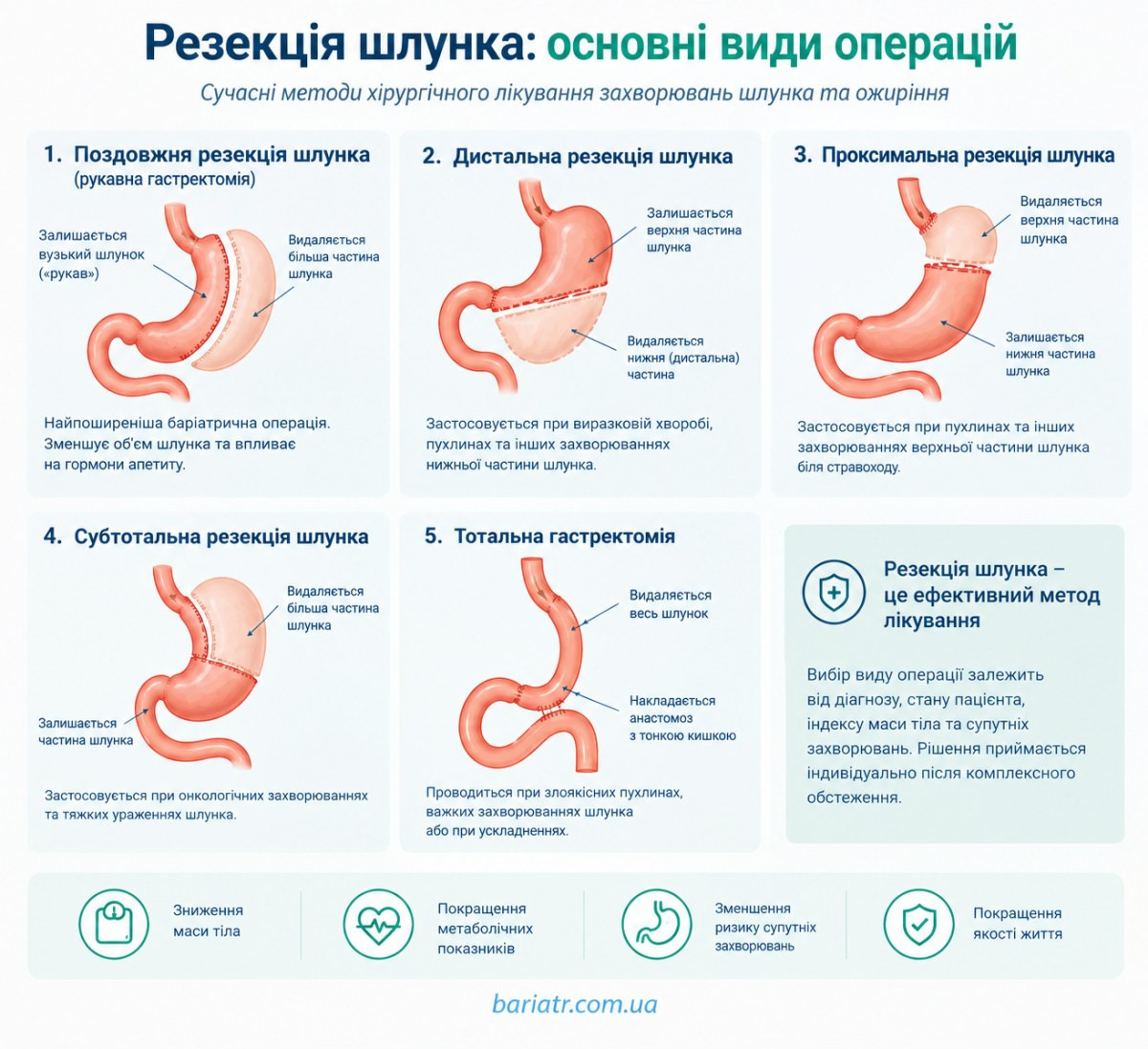
Sleeve gastrectomy
About 70–80% of the stomach is removed. It becomes a narrow tube.
What happens:
- Reduced food volume
- Lower levels of the hunger hormone (ghrelin)
- Decreased appetite
Average weight loss: 60–70% of excess weight.
Long-term effect.
Gastric bypass
Gastric bypass
A small stomach pouch is created and the route of food through the intestines is altered.
This:
- Reduces food intake
- Decreases calorie absorption
- Strongly affects metabolism
Especially effective for type 2 diabetes.
Weight loss: 65–80% of excess weight.
How surgery differs from a balloon
| Parameter | Balloon | Surgery |
|---|---|---|
| Incisions | No | Laparoscopy |
| Duration of effect | 6–12 months | Permanent |
| Hormonal effect | No | Yes |
| Weight loss | Moderate | Significant |
| Weight regain | Frequent | Much less common |
When a balloon is sufficient
- BMI 27–32
- No diabetes
- Patient afraid of surgery
- Temporary measure needed
When a balloon is not enough
- BMI over 35–40
- Type 2 diabetes
- Long-term obesity
- Many failed weight-loss attempts
In these cases, surgical treatment is usually considered.
Cost of weight loss surgery (Ukraine)
Balloon: 45,000–80,000 UAH
Sleeve gastrectomy: 95,000–160,000 UAH
Gastric bypass: 130,000–220,000 UAH
Price depends on:
- Clinic
- Surgeon
- Included tests
- Hospital conditions
How safe it is
Modern bariatric surgeries are performed laparoscopically. The risk of serious complications is comparable to other planned surgeries.
According to American Society for Metabolic and Bariatric Surgery, bariatric surgery is an effective and proven method for treating obesity and metabolic disorders.
The main thing to understand
The balloon is a tool. Surgery is treatment.
If excess weight is significant and affects health, a temporary solution often delays the final step. If the problem is moderate - a balloon may be sufficient.